
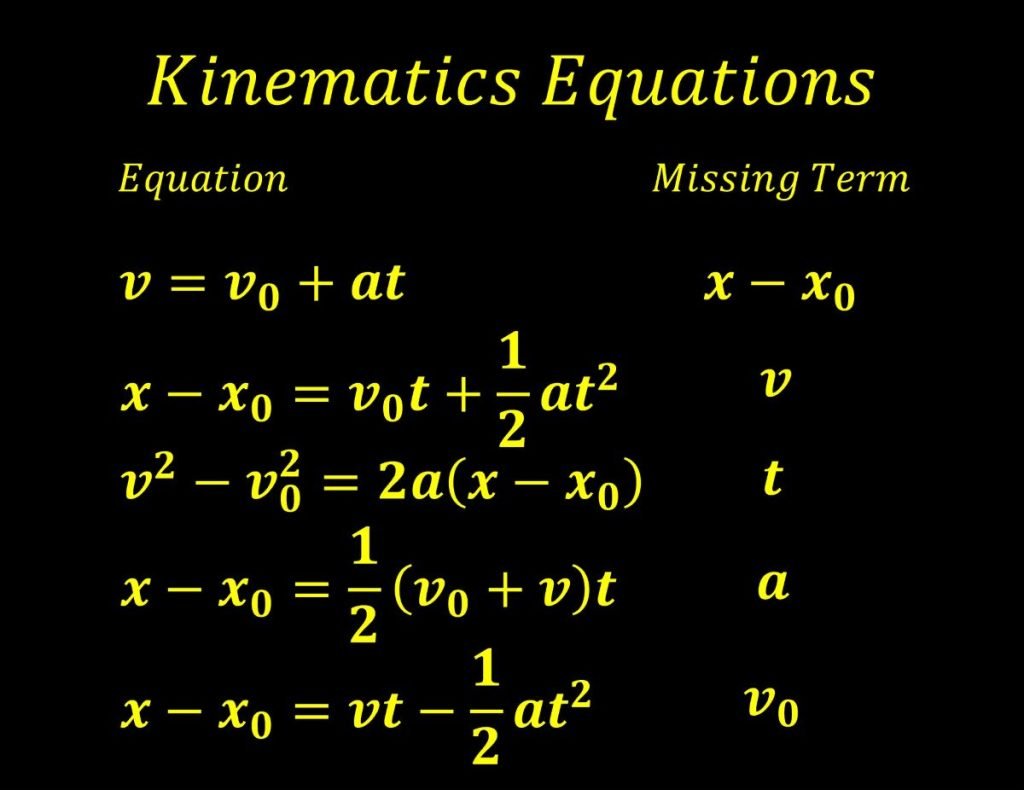
Understanding motion is a cornerstone of physics, and at the heart of this understanding lie kinematic equations. These equations allow us to describe the motion of objects in precise mathematical terms, helping us predict their positions, velocities, and accelerations over time. Whether in everyday scenarios or in advanced scientific research, mastering kinematic equations opens a door to a deeper appreciation of the physical world.
What Are Kinematic Equations?
Kinematic equations are mathematical formulas used to describe the motion of objects without considering the forces causing that motion. They are particularly useful in linear motion, where an object moves along a straight path with constant acceleration. These equations bridge the gap between conceptual understanding and practical calculation, providing a reliable framework for solving motion-related problems.
The core quantities involved in kinematics include:
- Displacement (s or x): How far an object has moved from its initial position.
- Initial velocity (u): The velocity of the object at the start of observation.
- Final velocity (v): The velocity of the object at a given moment.
- Acceleration (a): The rate at which the velocity of the object changes.
- Time (t): The duration over which the motion occurs.
By connecting these quantities, kinematic equations allow physicists, engineers, and students to predict motion outcomes with remarkable accuracy.
The Fundamental Kinematic Equations
There are four primary kinematic equations used in physics, applicable under constant acceleration. Each equation can be derived from basic principles of motion and calculus, but they are often presented in a straightforward form for ease of use.
- Equation for Final Velocity
v=u+at
This equation calculates the final velocity of an object when its initial velocity, acceleration, and the time of motion are known. It is particularly useful in scenarios where one wants to find out how fast an object is moving after a specific time period.
- Equation for Displacement with Initial Velocity
s=ut+21at2
This formula is ideal for determining how far an object has traveled after a given time, accounting for the effect of acceleration. It shows that displacement is not only influenced by the initial velocity but also by how the object’s speed changes over time.
- Equation for Displacement with Average Velocity
s=2(u+v)t
By taking the average of the initial and final velocities, this equation provides a simple method to find displacement without explicitly knowing the acceleration.
- Equation Connecting Velocity and Displacement
v2=u2+2as
This formula is particularly powerful because it links velocity directly with displacement and acceleration, bypassing the need to know the time. It is often used in situations like projectile motion, free fall, or any motion under constant acceleration.
Why Kinematic Equations Are Important
Kinematic equations are more than abstract formulas; they are tools that provide practical insight into the real world. Here are some reasons why they are so valuable:
- Predicting Motion: Whether designing a roller coaster or launching a satellite, kinematic equations allow engineers to predict where an object will be at a certain time.
- Safety Applications: Understanding the motion of vehicles, projectiles, or falling objects is essential in preventing accidents and designing safety systems.
- Scientific Research: In fields like astrophysics or biomechanics, kinematic equations help researchers model motion with precision, leading to discoveries about planetary orbits or human movement.
- Educational Value: For students, mastering these equations builds a foundation for advanced physics topics like dynamics, fluid mechanics, and electromagnetism.
Real-Life Applications of Kinematic Equations
The concepts behind kinematic equations are not confined to textbooks; they are visible in our daily lives and technological advancements. Here are some examples:
- Sports Analysis: Coaches use motion equations to track the trajectory of balls, predict the speed of athletes, and optimize performance.
- Transportation Engineering: Kinematic principles help design roads, ramps, and braking systems for vehicles, ensuring smooth and safe motion.
- Space Exploration: Calculating spacecraft trajectories, landing sequences, and orbital mechanics all rely heavily on kinematic equations.
- Entertainment Technology: Video games and animations use these equations to simulate realistic motion, from racing cars to flying characters.
Common Mistakes to Avoid
Even experienced learners sometimes misapply kinematic equations. Understanding the pitfalls can save time and ensure accuracy:
- Assuming Constant Acceleration When It’s Not: Kinematic equations only work under constant acceleration. Variable acceleration requires calculus-based approaches.
- Mixing Units: Time, velocity, and displacement must be consistent. For example, meters and seconds are standard; mixing these with kilometers or minutes can lead to errors.
- Ignoring Direction: Motion is vectorial. Positive and negative signs indicate direction and are crucial for accurate results.
- Forgetting Initial Conditions: Always check the initial velocity and displacement before applying equations.
Tips for Mastering Kinematic Equations
- Visualize the Motion: Draw diagrams and mark velocities, accelerations, and displacements to clarify the problem.
- Understand the Derivations: Knowing where the equations come from deepens conceptual understanding and improves problem-solving skills.
- Practice Different Scenarios: From free-falling objects to horizontally launched projectiles, varying problems enhance adaptability.
- Check Results for Reasonableness: Ask yourself if the final answer makes physical sense before finalizing it.
Conclusion
The study of kinematic equations is a journey into the elegant simplicity of motion. By mastering these equations, one gains not only the ability to solve physics problems but also a deeper appreciation for the predictable beauty of the physical universe. Whether you are a student, an engineer, or a curious mind, these equations offer a window into understanding how everything moves—from the smallest particle to the largest celestial body.
Embracing kinematics opens the door to innovation, safety, and discovery. While seemingly abstract at first glance, these equations are, in reality, powerful tools that connect the laws of physics with everyday life. The next time you watch a ball soar, a car accelerate, or a rocket launch, remember that kinematic equations are silently guiding your understanding of the motion you witness.
