
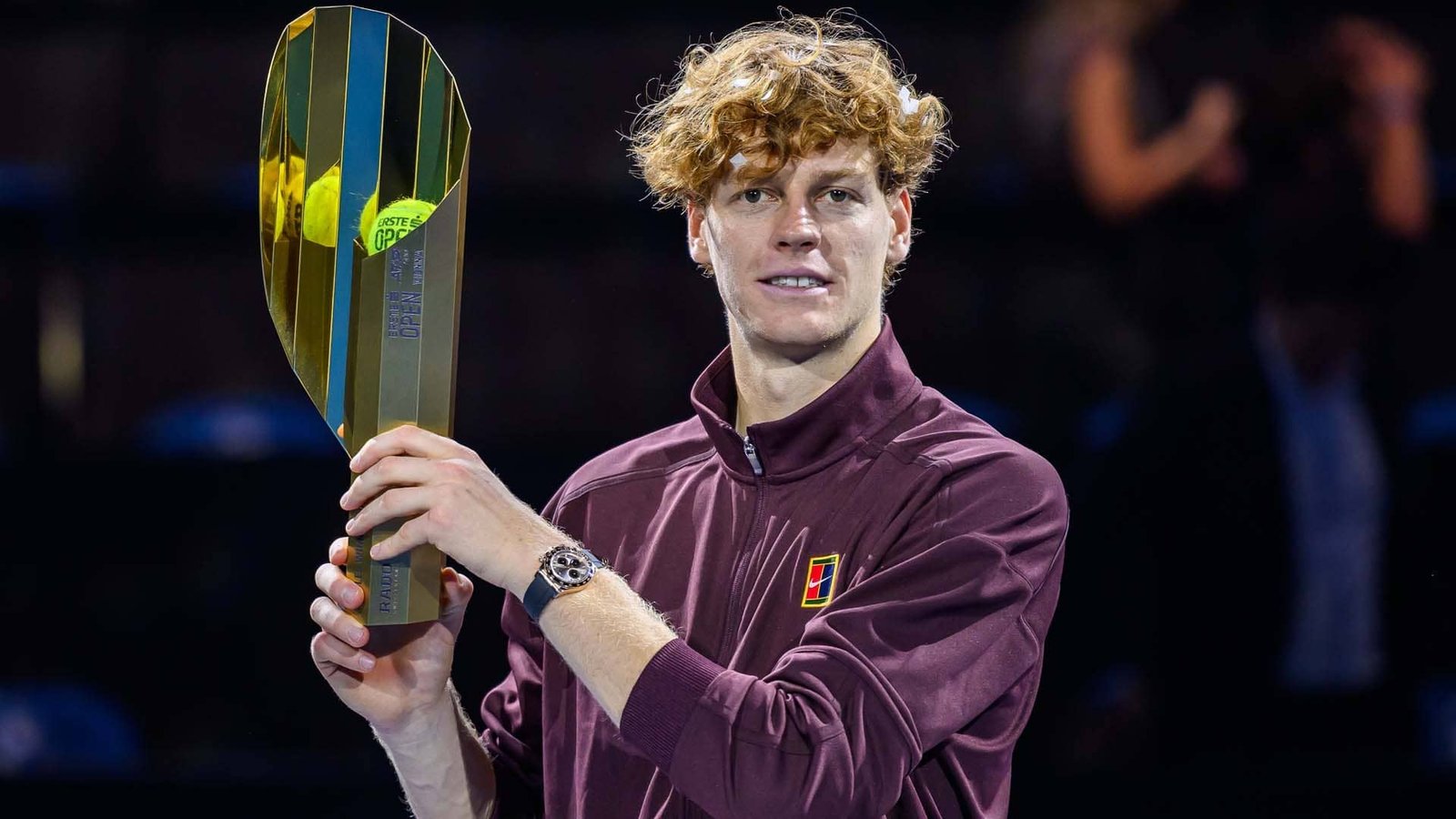
Modern men’s tennis is defined by speed, power, and relentless pressure. Baseline rallies are faster, serves are heavier, and the margin for error has never been smaller. In this unforgiving environment, certain matchups rise above the rest—not just because of rankings or trophies, but because of the pure danger they represent on court. One such matchup is Jannik Sinner versus Andrey Rublev. Whenever these two meet, the contest feels volatile, explosive, and unpredictable, even when the scoreline suggests control. This is not just another rivalry; it is a collision of force, discipline, and mental intensity that makes every point feel decisive.
Two players, one brutal philosophy
At their core, both Sinner and Rublev believe in aggressive tennis. They are not content to simply outlast opponents; they aim to impose themselves. Sinner’s game is built on clean mechanics, early ball striking, and relentless depth. He hits through the court with remarkable consistency, taking time away from opponents while maintaining balance and composure. Rublev, on the other hand, is raw intensity personified. His forehand is one of the most destructive shots in the sport, struck flat and hard, designed to overwhelm rather than outmaneuver.
When these philosophies collide, rallies become acts of controlled violence. There is little room for neutral play. Each shot carries intent, and each exchange threatens to swing momentum instantly.
The contrast that creates danger
What makes Sinner vs Rublev particularly dangerous is not similarity, but contrast. Sinner thrives on structure. He builds points patiently, absorbs pace, and waits for the precise moment to strike. Rublev thrives on disruption. He looks to end points quickly, forcing opponents into rushed decisions and defensive positions.
This contrast produces matches where momentum is constantly under threat. Sinner may appear in control for several games, only for Rublev to unleash a barrage of winners that flips the set within minutes. Conversely, Rublev may dominate early with sheer aggression, only to see Sinner gradually defuse his power and take over through consistency and placement.
The danger lies in this instability. No lead ever feels entirely safe.
Physical power meets mental pressure
Physically, both players are elite. They can sustain high-intensity rallies for hours, striking the ball with near-maximum force repeatedly. But the real danger of this matchup emerges on the mental level. Each player knows that hesitation is fatal. Against Rublev, giving a short ball is an invitation to disaster. Against Sinner, losing patience often leads to unforced errors.
This creates psychological stress that builds with every rally. Players are not only fighting the opponent but also resisting their own impulses—Rublev trying not to overhit, Sinner resisting the temptation to become too passive. The match becomes a test of emotional control under extreme physical strain.
sinner vs rublev is most dangerous check
This phrase captures the essence of the rivalry better than any statistic. Sinner vs Rublev is most dangerous check because it functions like a verification of elite tennis readiness. When these two step on court, the match checks everything: timing, endurance, shot tolerance, emotional discipline, and tactical clarity. There is no hiding weakness. Any drop in intensity is immediately punished. The danger is constant, not because of chaos, but because of precision delivered at extreme speed.
Serve and return: the first battlefield
The serve plays a critical role in determining the flow of their matches. Sinner uses his serve strategically, aiming for placement and variation to set up the next shot. Rublev’s serve is more direct, often used to gain immediate control of the rally or finish points outright.
Return games become especially dangerous. Both players stand close to the baseline, taking returns early and aggressively. A single poor service game can decide a set, and breaks often come in sudden, brutal sequences rather than slow attrition. This creates matches where tension remains high even in routine service games.
Baseline warfare and depth control
Once rallies begin, depth becomes the central currency. Sinner excels at pinning opponents behind the baseline, using depth and angle to stretch the court. Rublev responds by flattening his shots, trying to take time away and step inside the court.
These baseline exchanges are physically punishing and mentally draining. Long rallies do not necessarily favor either player; instead, they increase the likelihood of a sudden strike—a forehand winner, a backhand down the line, or a forced error under pressure. The danger is not just losing the point, but losing confidence in one’s rally tolerance.
Momentum swings and emotional intensity
Few matchups on tour feature momentum swings as sharp as Sinner vs Rublev. Rublev is known for emotional intensity, riding waves of energy that can lift him to extraordinary levels or, if disrupted, cause frustration. Sinner, more reserved, absorbs these surges and often responds with calm efficiency.
This emotional contrast heightens the drama. A single break of serve can trigger a cascade—either Rublev exploding with winners or Sinner tightening his grip and draining belief from his opponent. Fans watching these matches often feel that the match is balanced on a knife’s edge, regardless of the score.
Why this rivalry matters for modern tennis
Beyond entertainment, this rivalry represents the direction of modern tennis. It shows how the game has evolved into a test of sustained aggression rather than isolated brilliance. Both players embody a generation that grew up hitting harder, earlier, and with less margin.
Their matches answer an important question: is controlled aggression superior to pure power, or can relentless force still break even the most composed defenders? Each encounter adds another layer to that answer, making the rivalry meaningful beyond wins and losses.
What to watch in future encounters
Future Sinner vs Rublev matches will likely hinge on small adjustments. Can Rublev vary his patterns enough to avoid predictability? Can Sinner maintain depth without becoming passive? Will either player introduce more net play or tactical variety to disrupt the baseline rhythm?
These questions ensure that the rivalry remains dangerous, not just physically, but strategically. Both players are still evolving, which means their clashes will continue to surprise.
Final reflection: danger as beauty
In tennis, danger often produces beauty. The Sinner–Rublev rivalry is a perfect example. Their matches are not beautiful because they are gentle or artistic, but because they are uncompromising. Every point feels earned, every winner feels heavy, and every mistake feels costly.
This is why fans and analysts alike circle their meetings on the calendar. Sinner vs Rublev is not merely a match—it is an examination of modern tennis at full speed, where elegance is forged under pressure and danger is never more than one swing away.
