
Introduction
For people living or working in Qatar — particularly migrant workers — the Qatar ID (often referred to as QID) is far more than just a piece of plastic. It is the document that determines whether you can work legally, travel, live, access services, or even stay in the country. When a QID check goes wrong — whether because the ID is expired, incomplete, cancelled, or mismanaged — the consequences can be severe. In many cases, a seemingly routine document check becomes a door to serious danger: loss of job, blocking of essential services, fines, detention, or even deportation.
This article explores how and why a QID check in Qatar can become one of the most dangerous checks a migrant can face — and why vigilance is often not enough to avoid that danger.
What the Qatar ID Represents
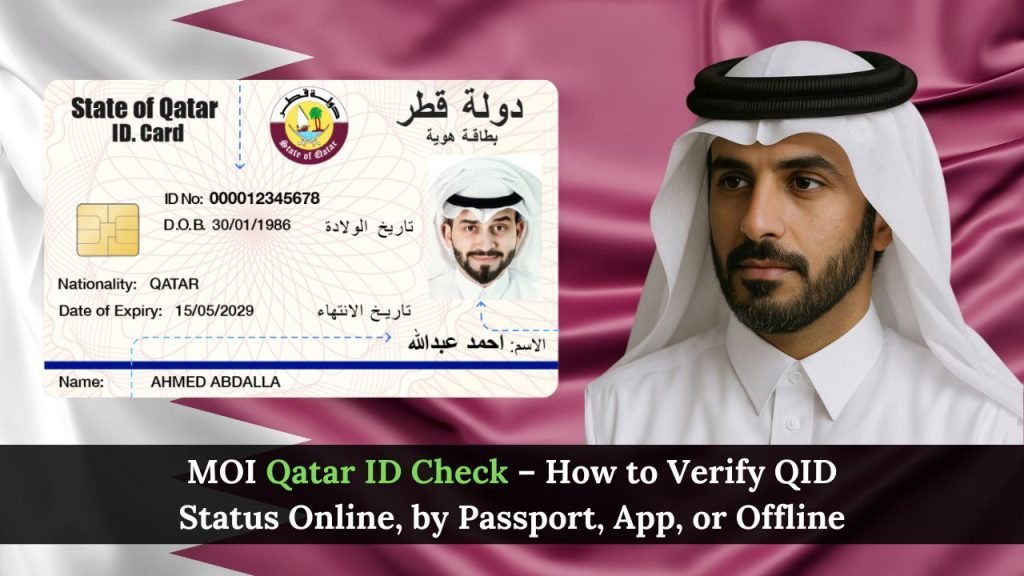
The Qatar ID card is the primary proof of legal residency and authorization to work or stay in Qatar. Without a valid QID, a foreign resident may:
- Be unable to legally work or receive salary.
- Be denied access to essential services like healthcare, banking, and housing.
- Face problems with travel: entry into the country, exit, or return may be blocked without a valid and current QID.
In effect, the QID is the foundation of a migrant worker’s legal status and daily life in Qatar.
Because of this pivotal role, anything that invalidates or blocks the QID — or makes it difficult to prove it upon ID check — can instantly jeopardize everything else.
How Qatar ID Checks Work — And Why They Fail
The process of obtaining and maintaining a QID often involves several steps and interactions with employer/sponsor and official authorities. Failure or irregularities at any point can lead to complications. Common issues that lead to failed verification or invalid QID include:
- Incomplete or incorrect documentation — errors in personal data, mismatches between passport and visa, or missing medical/fingerprint registration.
- Sponsor or employer issues — for example, if the sponsoring company is not properly registered or the visa does not match the contract.
- Late application or delay in renewal — for work visas, the QID must be issued or renewed within a stipulated timeframe, otherwise application may be denied or delayed.
- System or administrative errors — sometimes issues arise from technical problems, bureaucracy, or mistakes within the authorities’ database.
Any of these can lead to a QID being declared invalid, blocked, or cancelled — which has immediate and serious repercussions.
Consequences of an Invalid or Blocked Qatar ID
When a QID is invalid or blocked, the effects ripple through every aspect of a resident’s life:
✅ Loss of Access to Basic Services
- Healthcare: Without a valid QID, access to both emergency and routine medical care can be denied.
- Banking and finance: Essential services like bank accounts, ATM withdrawals, payments, or use of bank cards may be frozen.
- Housing and utilities: Renting accommodation, renewing lease agreements, obtaining utilities (water, electricity, internet) may become impossible.
✅ Work and Salary—Immediately at Risk
For many migrant workers, employment is directly tied to a valid QID. If the ID is cancelled or expired:
- Work may be suspended or terminated.
- Salary may be withheld or delayed.
- It may become impossible to accept new employment or renew work permits, making a worker effectively jobless with no legal status.
✅ Legal Exposure: Fines, Detention, Deportation
Invalid QID can instantly change one’s status to “illegal resident,” which has serious legal consequences:
- Daily fines begin to accumulate (e.g., a fine per day of overstaying or being without valid ID).
- Risk of arrest and detention: According to immigration laws, staying without valid residence or visa can be grounds for detention, especially under certain sections that deem such residents a threat to public order.
- Deportation or forced repatriation — often with little or no possibility to reclaim unpaid wages or benefits.
Why ID Checks in Qatar Are Particularly Dangerous for Migrant Workers
The Power Imbalance of the Sponsorship System
Although some reforms have been implemented in recent years, many migrant workers in Qatar remain under a system where their residence permit and QID depend on a sponsor (employer).
This dependency means that if the employer cancels the visa or refuses to process renewal — intentionally or not — the worker is left vulnerable. Without their own control over ID renewal, workers lack the agency to ensure their legality.
In some cases, workers reportedly have their passports or IDs confiscated by employers or sponsors — a practice linked to abuse, exploitation, or fear of workers “running away.”
A Single Check Can Destroy What Took Years to Build
Because all essential services — from work, salary, housing, banking, to healthcare — rely on QID validity, a single check (e.g., police stop, routine verification, employer audit) can trigger a cascade: loss of job → inability to pay for housing or food → being stuck without legal status → potential detention or deportation.
For many migrant workers, especially low-income or unskilled laborers, this can mean instant destitution.
Systemic Vulnerabilities and Abuse of Enforcement
Reports from human-rights organizations suggest that even with reforms, many workers remain vulnerable to abuses — restricted freedom of movement, arbitrary detention, passport retention, nonpayment of wages, and exploitation.
In practice, random ID checks — at checkpoints, workplaces, construction sites, or by police — may disproportionately target migrants. When ID is missing or invalid, the consequences fall on individuals who may have little recourse.
Limited Legal Protection and Barriers to Redress
Migrant workers often lack proper channels to challenge wrongful cancellation of QID or sponsor-related abuses. Trade unions are generally not allowed for most migrant workers; legal rights to file complaints or obtain compensation may exist on paper but are hard to enforce in reality.
Because of these structural and legal limitations, even lawful migrant residents may find themselves trapped — unable to fix their status, denied services, and exposed to fines or deportation.
opments: Amnesty Program and Temporary Relief — But Still Risky
In early 2025, the Ministry of Interior Qatar announced a three-month amnesty for undocumented migrant workers — those whose residence visas expired or who overstayed — allowing them to leave without penalty or detention.
While this amnesty provides short-term relief for some, it also underscores how precarious the status of many migrant workers remains. For those without valid QIDs, the only realistic option may be to leave the country — rather than risk fines, arrest, or indefinite detention.
It also reflects how the system treats documentation status as a matter of administrative compliance rather than as a foundation for human dignity, safety, or stable residence.
Why a Qatar ID Check Can Be More Dangerous Than It Seems
Putting all these together, here’s why a QID check is among the most dangerous checks a migrant resident of Qatar can face:
- It touches every aspect of life. One check can jeopardize job, salary, housing, healthcare, utilities, banking, and ability to stay or travel.
- It operates under a structurally unequal system. Migrant workers depend on sponsors for their legal status, with limited personal control over renewal or documentation.
- Enforcement is harsh and unforgiving. Legal penalties, detention, deportation — all can follow swiftly upon invalid ID detection.
- Redress options are limited. Whether due to employer abuse, administrative error, or miscommunication, the worker often bears the consequences.
- The system magnifies vulnerability. Migrant workers — often from poorer countries, with limited social networks in Qatar — can be plunged into crisis without warning.
In short: a Qatar ID check isn’t a simple verification of documents — it can be a turning point between legal security and severe hardship.
Real-World Implications: Who Is Most at Risk
Although the QID system affects all residents, certain groups are particularly vulnerable:
- Low-wage migrant laborers, domestic workers, construction workers. These often depend entirely on their sponsor for everything — pay, housing, transport, documents. Any sponsor-related issue or administrative blunder can instantly jeopardize their situation.
- Workers who change jobs, exit employers, or leave Qatar temporarily. Since QID renewal and validity typically depend on employer/sponsor intervention, job changes or absences can trigger visa or ID cancellation — and leave workers ‘illegal’ despite no wrongdoing.
- People unaware of bureaucratic requirements. Document errors, missed renewal deadlines, or incomplete paperwork — often due to lack of guidance or misinformation — can lead to failure.
- Workers with limited resources or social support. Without a safety net — financial, legal, or community — one mistake can mean destitution or forced return to home country.
What Should Migrant Residents Know — and Watch Out For
If you are living in Qatar (or planning to), and rely on a QID for residence and work:
- Treat the QID as an essential “life document,” not just a formality. Keep track of expiry dates, renewals, and sponsor status.
- Always carry your QID (or a verified digital copy if allowed) — in Qatar even law-abiding residents may be stopped and asked for ID.
- Avoid signing away custody of your ID or passport to employers or sponsors — retaining control helps avoid loss or wrongful withholding.
- Double-check all documentation when applying or renewing — name spellings, passport details, visa types, medical tests, fingerprints, and employer paperwork must match.
- Be aware that administrative or technical issues (system downtime, database errors, delays) can disrupt QID validity — check status online regularly using official portals or authorised apps.
- If facing denial, cancellation, or employer-related issues — seek legal or consular help early. Don’t wait until fines or deportation become imminent.
Conclusion: QID Check — A Dangerous Gatekeeper
The Qatar ID card is much more than a residency permit — it is the key to a migrant’s entire life in Qatar. A QID check, therefore, is not a mere formality: for many, it is a dangerous gatekeeper that can determine whether they stay, work, eat, access healthcare or live in dignity — or face fines, detention, loss of livelihood, or deportation.
Structural issues in the documentation system, the dependency on employers/sponsors, bureaucratic complexity, and the vulnerability of migrant populations make a bad QID check potentially catastrophic. In a system where one document underpins every basic human need, losing that document — even through no fault of your own — can throw everything else into chaos.
For migrant workers, especially those in precarious jobs, the “Qatar ID check” is not simply a check: it is a constant threat.
